Understanding AI Model Families
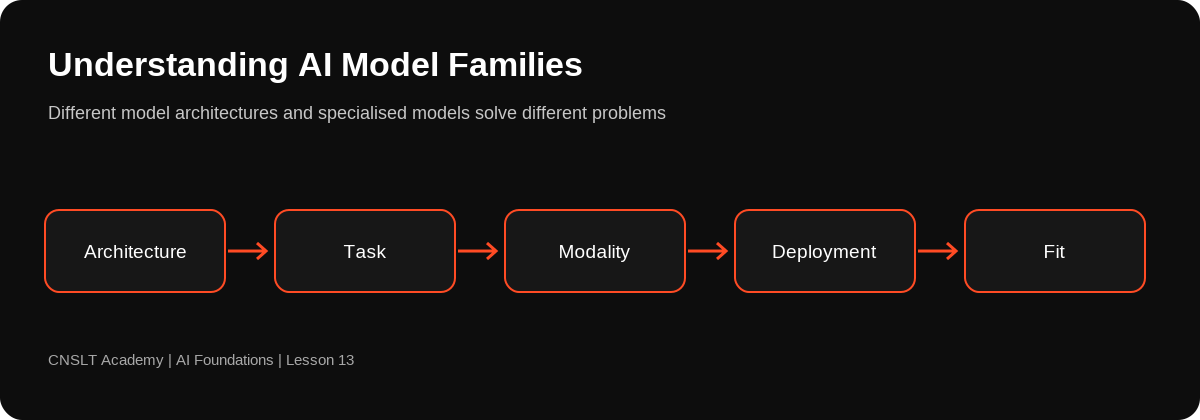
Distinguish model architecture, task, modality and deployment; recognise major model families; and understand why model choice depends on the task.
##
- Four dimensions that are often confused
A model can be described by:
- Architecture: how the model is structured, such as encoder-only, decoder-only or encoder-decoder.
- Task: what it is designed or adapted to do, such as generation, classification, embedding or reranking.
- Modality: what information it accepts or produces, such as text, image, audio or video.
- Deployment and licence: how it is hosted and what usage rights and restrictions apply.
These dimensions are related but not interchangeable. “Open-weight” describes access to parameters, not a model architecture or a guarantee of open-source licensing.
##
- Transformer foundation
Many modern language models use the Transformer architecture. Attention mechanisms allow a model to weigh relationships between tokens in a sequence. Feed-forward layers and other components transform the representations. The original Transformer paper introduced an architecture based on attention rather than recurrence as the central sequence-processing mechanism.
##
- Common architecture families
- Encoder-only: builds contextual representations of input. Often useful for classification, extraction and embeddings. BERT is a familiar example.
- Decoder-only: predicts subsequent tokens and is widely used for generative language models. GPT-style models and many open-weight LLMs use this pattern.
- Encoder-decoder: encodes an input and generates an output. T5 is a well-known text-to-text example.
Architecture alone does not tell you the exact quality, safety or suitability of a particular model.
##
- Specialised model types
- Embedding model: maps text or other inputs into vectors used for semantic search, clustering or retrieval.
- Reranker: scores candidate results for relevance and reorders them.
- Classifier: assigns labels or categories.
- Vision model: interprets images or video frames.
- Speech/audio model: transcribes, classifies, understands or generates audio.
- Multimodal model: handles more than one modality.
- Generative LLM: generates text or structured outputs.
A production system can combine several model types. A retrieval-augmented assistant might use an embedding model to retrieve candidates, a reranker to order them and a generative model to compose an answer.
##
- Foundation vs specialised models
A foundation model is trained on broad data and can support many downstream tasks. A specialised model may be adapted or trained for a narrower task or domain. Specialisation can improve performance or efficiency for a defined task, but it does not automatically improve safety or generalisation.
##
- Open-weight vs open-source
Open-weight models make some or all trained parameters available. Open-source status depends on the licence and availability of the relevant source, data and rights. A model can have downloadable weights but still impose usage restrictions. Always review the actual licence, acceptable-use terms, training-data disclosures and redistribution conditions.
##
- Example: security operations assistant
A SOC workflow may use:
- embeddings to find similar historical incidents
- a reranker to prioritise relevant incidents
- a classifier to categorise an alert
- a generative model to summarise evidence
- a human analyst to approve response actions
The model family should follow the task. Do not use a large generative model for every subtask merely because it is available.
##
- Practical exercise
For a security assistant, select a model type for semantic incident search, phishing classification, image-based evidence review and narrative incident summarisation. Explain the evidence needed before selecting a specific model.
##
- Knowledge check
- Are architecture and task the same thing?
- What is an embedding model used for?
- What does a reranker do?
- Does open-weight necessarily mean open-source?
- Why might a system use several model types?
Answer key:
- No.
- Vector representations for similarity and retrieval tasks.
- Re-scores and reorders candidate results.
- No.
- Different subtasks have different performance, cost and control requirements.
##
- Checklist
- [ ] Define the task before selecting a model family.
- [ ] Identify input and output modalities.
- [ ] Separate architecture from task and deployment.
- [ ] Review model licence and usage restrictions.
- [ ] Evaluate each component in a multi-model pipeline.
- [ ] Document limitations and fallback behaviour.
##
- Further reading
Help improve this learning path.
Suggest a concept we should teach, or tell us what is unclear. No account is required. Email is optional and only for a reply. Do not include confidential or sensitive information.