Multimodality
Define modality, explain common multimodal processing patterns, identify practical applications and assess modality-specific risks.
##
- What is a modality?
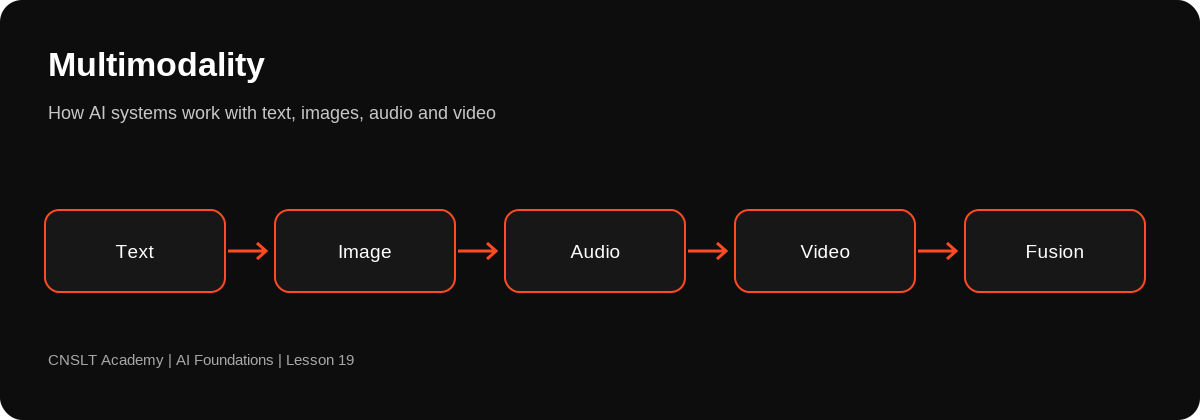
A modality is a type of information or signal. Text, images, audio and video are common modalities. A multimodal system can accept or generate more than one modality. This does not mean every model handles every modality equally well.
##
- How multimodal processing works
A simplified pipeline may include:
- input capture and validation
- preprocessing, such as resizing an image or segmenting audio
- conversion into representations the model can process
- model reasoning or prediction across the available representations
- output generation, such as text, audio or a structured label
- application validation and presentation
Implementations vary. Some systems use one model across modalities; others combine specialised encoders, decoders and orchestration components.
##
- Images
Image systems may resize images, divide them into patches or regions, and encode visual features. A model may describe objects, extract text, compare images or answer questions about a scene. Image quality, resolution, cropping, lighting and context can affect results.
A screenshot or photograph can contain instructions as well as data. Treat text inside an image as untrusted content. A visual prompt injection can attempt to influence the model just like hostile text in a document.
##
- Audio
Audio tasks include speech recognition, transcription, speech understanding, speaker-related analysis, sound classification and speech generation. These are distinct tasks and have different accuracy and privacy implications. Background noise, accents, overlapping speakers and recording quality can affect results.
Voice can contain personal or biometric information. Obtain appropriate authority and consent, limit retention and avoid treating a voice match as definitive identity proof without a validated process.
##
- Video
Video contains sequences of frames and temporal information. Systems may sample frames, analyse selected segments or combine visual and audio streams. Sampling can miss brief events. A summary of a few frames is not equivalent to a complete understanding of a continuous recording.
##
- Fusion patterns
- Early fusion: combine modality representations relatively early in processing.
- Late fusion: process modalities separately and combine their outputs later.
- Cross-modal interaction: representations from one modality influence processing of another.
The choice affects performance, complexity, explainability and failure modes.
##
- Applications and risks
Applications include document processing, accessibility, manufacturing inspection, medical support, education, customer service and security operations. Risks include prompt injection through images/audio, deepfakes, inaccurate transcription, privacy exposure, biometric misuse, missing temporal context, cross-modal leakage and overconfidence.
Evaluate each modality separately and test interactions between modalities. A system that performs well on clean text may fail on noisy speech or adversarial images.
##
- Practical exercise
Design an incident evidence assistant that accepts a screenshot, a voice note and a short video. Define what each modality contributes, what can be missed, which data is sensitive, how provenance is preserved and where human verification is mandatory.
##
- Knowledge check
- What is a modality?
- Why can frame sampling miss important events?
- What is the difference between early and late fusion?
- Why is image text a security concern?
- Why should voice identity claims be treated carefully?
Answer key:
- A type of information or signal.
- Short events may occur between sampled frames.
- Early fusion combines representations earlier; late fusion combines outputs after separate processing.
- It can contain malicious instructions or sensitive data.
- Voice is variable and can be spoofed; it may also be biometric personal data.
##
- Checklist
- [ ] Inventory input and output modalities.
- [ ] Validate file types, size and provenance.
- [ ] Define retention and consent requirements.
- [ ] Test noisy, low-quality and adversarial inputs.
- [ ] Test cross-modal prompt injection.
- [ ] Preserve timestamps and source evidence.
- [ ] Require human verification for high-impact conclusions.
- [ ] Evaluate each modality and combined workflows.
##
- Further reading
Help improve this learning path.
Suggest a concept we should teach, or tell us what is unclear. No account is required. Email is optional and only for a reply. Do not include confidential or sensitive information.