Model Selection
Build a model-selection process, compare deployment options, understand total cost of ownership, and document a defensible selection decision.
##
- Start with the business problem
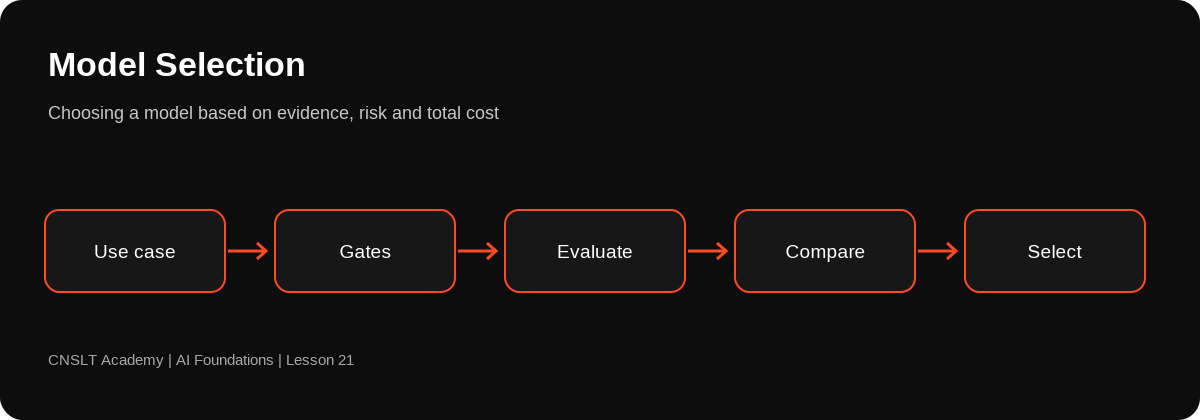
Do not begin by asking which model is most powerful. Begin with the task, user, decision, required quality, data sensitivity, operating environment and consequences of failure. A small classifier may be more appropriate than a large generative model. A human workflow may be safer than automation.
##
- Seven selection dimensions
- Capability: Does the model support the required task and modalities?
- Quality and reliability: Does it meet task-specific evaluation thresholds?
- Performance: Are latency, throughput and concurrency acceptable?
- Cost: What is the cost per successful task and total operating cost?
- Security and privacy: How are data, prompts, logs and credentials handled?
- Deployment: Is hosted, private-cloud, on-premises or local deployment suitable?
- Governance: Are licence, documentation, auditability, support and regulatory obligations acceptable?
A hard requirement should be a gate, not merely another weighted preference. A model that fails a mandatory privacy requirement should not win because it scores well on speed.
##
- Hosted, open-weight and specialised models
Hosted proprietary models may offer managed operations and strong capabilities, but require provider due diligence and dependency planning. Open-weight models can offer deployment control, but the organisation takes on infrastructure, security, patching, monitoring and licensing responsibilities. Specialised models may be efficient for narrow tasks, but must be tested on the actual data and environment.
Review the actual licence and terms. Open-weight does not automatically mean open-source or unrestricted commercial use.
##
- Evaluate before comparing
Build a representative test set, define scoring rules and test each candidate under the same conditions. Include normal, edge, adversarial and out-of-scope cases. Record model identifier, version, settings, prompts, retrieval configuration and date. Repeat tests where output variation matters.
Do not compare provider marketing benchmarks as if they were directly comparable. Different benchmarks, prompts, hardware and scoring rules can produce incomparable results.
##
- Performance and cost
Measure TTFT, inter-token latency, throughput, concurrency, rate limits and availability. Estimate total cost of ownership, including API usage or GPU infrastructure, storage, network, engineering, operations, security, monitoring, support and human review.
Illustrative calculation: 100,000 requests with 2,000 input tokens and 500 output tokens each means 200 million input tokens and 50 million output tokens. If assumed prices were 4 per million output tokens, the token charge would be 200 = $400. These are example rates only, not current provider pricing. Real pricing varies by model, tier, caching, region and additional modalities or tools.
Calculate cost per successful task, including retries and human correction.
##
- Prompting, RAG or fine-tuning?
- Improve the prompt when instructions or output structure are unclear.
- Use retrieval when the answer must rely on current or organisation-specific information.
- Consider fine-tuning when repeated task behaviour or format needs adaptation and there is suitable data and evaluation.
- Do not fine-tune merely to make a model memorise frequently changing facts.
These approaches can be combined. Each adds maintenance and evaluation requirements.
##
- Model routing
Some systems route simple tasks to a smaller model and complex tasks to a stronger model. Routing can reduce cost, but creates additional complexity: classification errors, inconsistent outputs, more failure paths and harder monitoring. Evaluate the router and each route as part of the full system.
##
- Weighted scorecard example
After mandatory gates are passed, an organisation may use a weighted scorecard. Example weights:
- quality 25%
- security/privacy 20%
- capability 15%
- performance 15%
- cost 10%
- deployment fit 10%
- governance/support 5%
Suppose ratings on a 1-to-5 scale produce weighted totals: Model A 3.85, Model B 4.30 and Model C 3.75. Model B ranks highest in this hypothetical example. The score is a decision aid, not objective truth. Record evidence and sensitivity to weights. Mandatory gates override the score.
##
- Governance lifecycle
Maintain a model inventory with owner, purpose, provider, model/version, data classes, integrations, evaluation evidence, licence, deployment, risk rating, approvals, monitoring and retirement plan. Reassess after material model or provider changes, incidents, new use cases or changes in data sensitivity.
##
- Practical exercise
Select a model for an internal policy assistant. Define mandatory privacy and security gates, build a test set, compare two hosted and one self-hosted option, calculate cost per successful answer and document the rationale and residual risks.
##
- Knowledge check
- Why should model selection begin with the use case?
- What is a mandatory gate?
- Why is open-weight not the same as open-source?
- When is retrieval more appropriate than fine-tuning?
- Why is cost per successful task better than cost per request?
Answer key:
- The use case defines required capability, quality, risk and constraints.
- A non-negotiable requirement that disqualifies a candidate if unmet.
- Weight availability does not establish the licence or availability of all source components.
- When answers must use current or organisation-specific information.
- It accounts for quality, retries and human correction.
##
- Checklist
- [ ] Define task, users, impact and data classes.
- [ ] Set mandatory security, privacy and legal gates.
- [ ] Evaluate candidates on a common test set.
- [ ] Measure quality, robustness and performance.
- [ ] Calculate total cost and cost per successful task.
- [ ] Review licence, support and provider terms.
- [ ] Document scorecard assumptions and evidence.
- [ ] Assign an owner and reassessment triggers.
- [ ] Maintain fallback and retirement plans.
##
- Further reading
Help improve this learning path.
Suggest a concept we should teach, or tell us what is unclear. No account is required. Email is optional and only for a reply. Do not include confidential or sensitive information.